Emergency Water Heater Repair in Melrose, MA
Water heater repair means finding why a tank or tankless unit stopped heating, started leaking or began making noise, then fixing that part or telling you straight when the unit is finished. If water is pooling around the heater or the hot tap has gone cold, call our 24/7 line and a dispatcher will take the details and send a technician.
While you wait, shut off the cold water supply to the heater and turn off the gas control or the breaker. Those two steps stop most damage before anyone arrives.
- 24/7 line
- Gas, electric, hybrid
Leaking tank or no hot water: do this while you wait
A leaking water heater can release a lot of water quickly, so the first few minutes matter. Work through these in order and stop if anything feels unsafe.
- 1
Close the cold supply
Find the shutoff valve on the pipe feeding the top of the heater and turn the handle clockwise until it stops. If the handle is stuck, close the main water valve instead.
- 2
Cut the fuel or power
On a gas unit, turn the gas control knob to pilot or off. On an electric or hybrid unit, switch off its breaker at the panel. Never leave an electric element powered with an empty tank.
- 3
Protect the floor
Put towels or a bucket in the path of the water and lift boxes or stored items off the floor. A wet vacuum helps if you own one.
- 4
Smell for gas
If you smell gas at any point, leave the building, do not touch switches, and call your gas utility or 911 from outside. Call us after that.
- 5
Call and describe what you see
Tell the dispatcher where the water is coming from, the fuel type and roughly how old the heater is. That lets the technician bring the right parts.
If the water is hot, keep children and pets away from the puddle. Do not open the drain valve unless you know where the hose will run.
What the symptom usually means
Most water heater calls fall into a handful of patterns. Here is how we read them at the door.
Water at the base
A drip from a fitting, the relief valve or the drain valve can often be repaired. Water seeping from the tank body itself, or rust streaks on the jacket, points to a failed tank.
No hot water at all
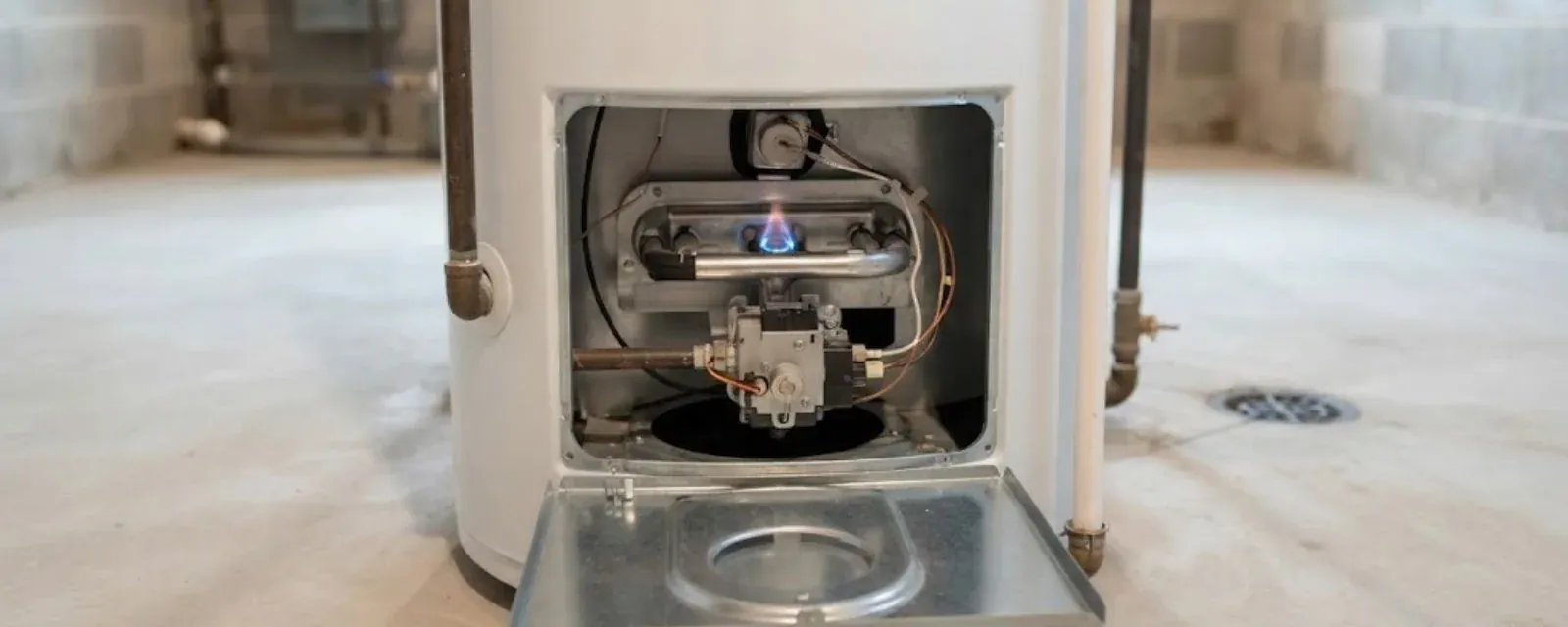
On gas units we check the pilot, thermocouple and gas supply. On electric units we check the breaker, reset button, thermostats and heating elements.
Lukewarm or runs out fast
A broken dip tube, a failed lower element or heavy sediment all shorten the hot supply. Each has a different fix, so the test comes first.
Popping or rumbling
Those sounds are usually minerals baked onto the tank bottom or the element, with water trapped under them. Flushing helps early on. Thick buildup may not come out.
Water on the floor right now?
Our dispatch line is open all night and on weekends. Shut off the supply first, then call.
Gas, electric and hybrid water heater repair
The fuel type decides what fails and what a repair visit looks like. A hybrid is an electric tank with a heat pump on top, so it shares electric faults and adds its own.
| Type | Common faults | What we check first |
|---|---|---|
| Gas tank | Pilot will not stay lit, bad thermocouple, dirty burner, blocked flue | Pilot and thermocouple, gas supply, venting and draft |
| Electric tank | Failed heating element, bad thermostat, tripped high-limit reset, tripped breaker | Breaker, reset button, then element and thermostat readings |
| Hybrid (heat pump) | Fan or filter clogged, error code, condensate drain blocked, element fault | Display code, air filter, condensate line, backup elements |
| Tankless | Error code, scale in the heat exchanger, flame or igniter fault, vent problem | Code lookup, inlet filter, flow and vent check |
Fault lists describe common patterns, not a diagnosis. Your unit's model and age change the answer.
Gas appliance work is safety work. A flame that burns yellow, a sooty burner or a draft problem is not a do-it-yourself job. Our tankless water heater service page covers on-demand units in more detail.
Pilot, igniter, sediment and the relief valve
On older gas heaters, a pilot that keeps going out is usually a worn thermocouple or a dirty pilot tube. Newer models use an electronic igniter instead, and a bad igniter or flame sensor shows up as a clicking sound with no flame. Both are small parts and quick to replace.
Sediment is the other steady cause of trouble. Minerals settle at the bottom of any storage tank over time, and the burner or element then works through a layer of crust. The Melrose water report from MWRA gives no hardness figure, so the only way to know how fast your tank collects scale is to look at what comes out of the drain valve during a flush.
The temperature and pressure (T&P) relief valve is a safety part. It opens if the tank gets too hot or the pressure climbs too high, and it should have a discharge pipe running toward the floor. If that pipe is dripping, the valve may be worn or the home may have a pressure problem, such as a closed system without an expansion tank. Never cap the valve or plug the pipe.
Repair or replace: a rough decision table
Tank life varies a lot by brand, water and use. As a general rule of thumb, a storage tank lasts about 8 to 12 years, and this table uses that range only as a starting point.
| Situation | Usually repair | Usually replace |
|---|---|---|
| Age | Under about 8 years | Past about 12 years, or showing rust |
| Leak location | Fitting, valve or relief pipe | Tank body or seam |
| No heat | Element, thermostat, thermocouple, igniter | Repeated failures within a year |
| Water quality | Rusty hot water only, with a new anode rod an option | Rusty hot water with a leaking tank |
| Repair cost | Small part and labor | Repair would be a large share of a new unit |
General guidance only. A technician will check the actual unit.
If the answer is replacement, our water heater replacement page walks through what happens next.
A leaking tank body cannot be repaired
Once water escapes through the steel shell, the tank lining has failed. Patching it does not work, and running it risks a larger flood. We shut it down, drain it if needed and move to a replacement plan.
Permits and hot water repair in Melrose
A repair that swaps a part, such as an element or thermocouple, is a different matter from a new heater. Melrose lists water heater fees on its permit fee schedule. Ask Inspectional Services whether your repair needs a permit. To confirm what applies to your job, call Melrose Inspectional Services at 781-979-4135. The office is on the ground floor of City Hall at 562 Main Street.
Source type: City of Melrose permit and fee pages
Questions we hear
Yes. Our dispatch line answers around the clock, including weekends and holidays. Shut off the supply before you call.
Close the cold water supply first if water is spilling. Then turn the gas control to off or pilot, or flip the electric breaker. If you smell gas, skip all of it, leave, and call your gas utility or 911 from outside.
Often it is the drain valve, a fitting, or the relief valve discharge. Sometimes it is condensation or a failed tank. A technician can tell the difference in a few minutes, and a seeping tank body means replacement.
Not safely. A small drip can turn into a full tank release without warning, and an electric element can burn out if the tank empties. Shut it off and keep the water supply closed until it is checked.
As a general rule of thumb, 8 to 12 years for a standard tank. Hard water, heavy use and missed flushing shorten that. Rust on the jacket or a puddle at the base are signs to plan ahead.
Yes, we work on gas, electric and hybrid units. Hybrids need a code check, a filter and condensate line inspection, and a look at the backup elements. Have the model number ready when you call.
If rust shows only on the hot side, the tank or its anode rod is the likely source. If cold water is also discolored, the cause is probably in the pipes or the supply. City main flushing can also stir sediment, so check whether it clears after running the cold tap.
Hot water back, problem understood
After a repair we explain what failed, what to watch for and whether the rest of the unit looks sound. If your home is in Malden, see our Malden plumbing page for nearby service.
Call (339) 216-9771