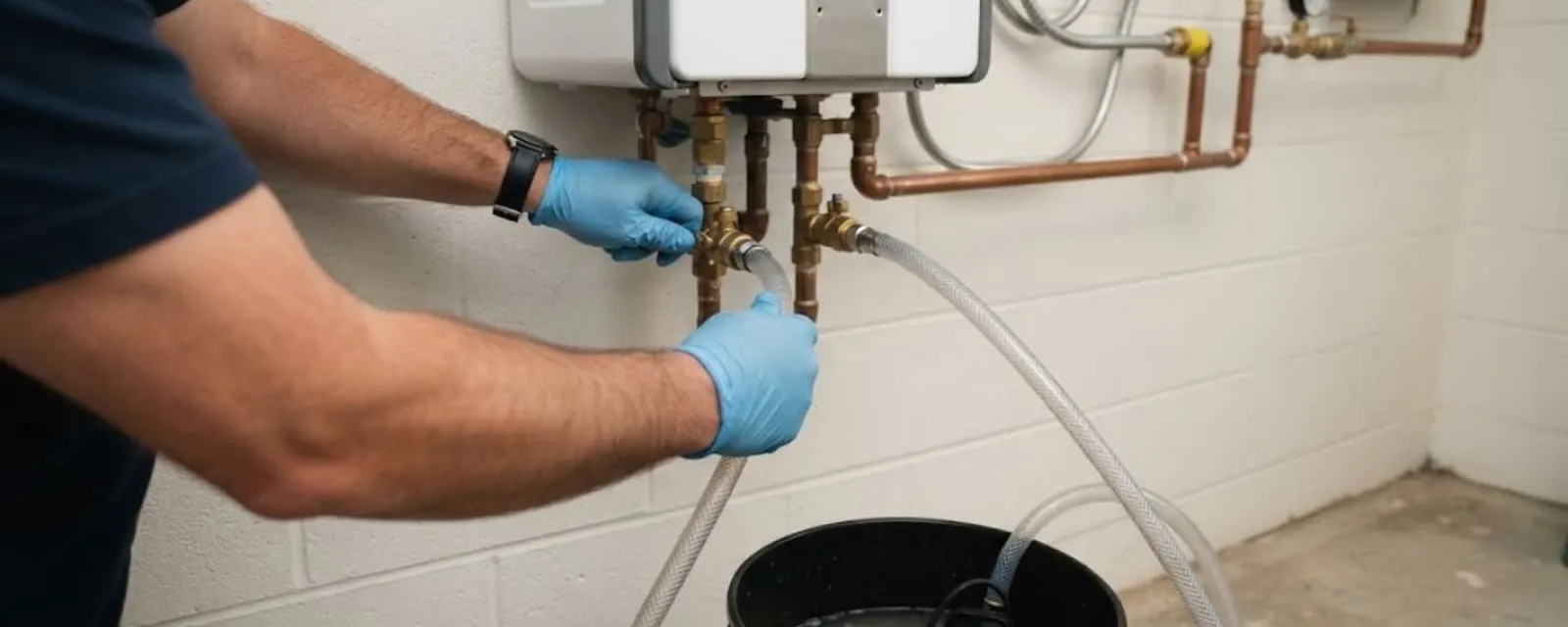
Why a relief valve exists at all
A relief valve is the last line of defense when pressure or temperature climbs past a safe limit. It opens, lets water out through a discharge pipe, and keeps the heater and your pipes from taking a pressure they were never built for. It has no electronics and no software, which is why it is trusted as a safety device.
On a storage tank, the temperature and pressure (T&P) valve is standard trade practice and familiar. It sits near the top of the tank and the tank holds 40 to 80 gallons that can expand and flash to steam. A tankless unit heats water only as it flows, so the stored volume is tiny. That is the reason people assume it needs no valve.
The catch is that the water pipes feeding the heater still hold pressure, and the burner or element can still overheat if a sensor fails. Manufacturers write their own protection requirements around those risks. If you are choosing a tankless water heater, the relief valve question belongs in the quote, not as a surprise on install day.
What the paperwork usually says, by setup
| Setup | Relief valve situation | What to confirm |
|---|---|---|
| Gas tankless, open water system | Often built into the unit or called for in the manual on the outlet side | Read the manual's installation diagram and the valve rating |
| Electric tankless, open water system | Manual may require a separate valve, or may say the unit has internal protection | Ask for the model's listing and its stated pressure limit |
| Any tankless behind a check valve or backflow device | Closed system, so heated water has nowhere to expand | Ask about a relief valve and an expansion tank together |
| Tankless feeding a recirculation loop | Extra volume and valves change how pressure behaves | Follow the recirculation kit instructions and the plumber's design |
| Tankless replacing an old tank heater | Old T&P discharge pipe may be reusable or undersized | Do not assume the old valve and pipe still fit the new job |
General guidance only. Your model's installation manual and your licensed plumber, working to the plumbing code, settle the real requirement.
The pattern is simple. The more closed-off your plumbing is, the more a relief valve matters. A plain open system with a built-in valve is the easy case, and a closed system with a backflow device is where installers earn their keep.
Tank heater versus tankless on relief protection
People often ask whether the valve rule is just a tank thing. It is not, but the details differ.
Storage tank heater
- Has a T&P valve that responds to both pressure and temperature
- Discharge pipe runs down toward the floor or a drain
- Valve is a standard part, easy to find and test
- Large stored volume means a big consequence if protection fails
Tankless heater
- Protection may be built in, external, or both, depending on the model
- Manual decides where the valve goes and what it must be rated for
- Small stored volume, but pipes upstream can still see pressure spikes
- Gas models add venting and combustion rules on top of the water side
Either way, a manufacturer may refuse a warranty claim on an installation that skips a required part. That alone is a practical reason to read the manual before the plumber arrives.
This is also why a swap from a tank to tankless is more than a box-for-box trade. A full water heater installation covers the water side, the gas or electric supply, the vent for gas models, and the discharge route for any relief valve. Each of those has its own rules.
Not sure what your heater has?
Tell the dispatcher the make and model off the data plate. We can talk through what your installation should include.
How to check your own tankless heater in ten minutes
- 1
Find the data plate
Look for a label on the side or bottom of the unit with the model number, serial number and maximum working pressure. Take a photo with your phone.
- 2
Look for a valve and a pipe
A relief valve has a lever or a brass body with a discharge pipe leading away. Check the water outlet piping and the cold inlet for one. Note whether the pipe ends somewhere safe.
- 3
Pull up the manual
Search the model number online and open the installation manual, not the user guide. Find the diagram showing the relief valve and the notes on closed systems.
- 4
Check for a check valve or backflow device
Look at the water meter area and main shutoff. A one-way device means the system is likely closed and needs a plan for thermal expansion.
- 5
Write down your questions
Bring the photos, model number and any code questions to the plumber. Ask who pulls the permit before you agree to the schedule.
If you find a valve with no discharge pipe, or a pipe that ends in a plugged cap, stop there. That is a sign to call a licensed plumber, not to fix it yourself.
Melrose note: water and permit fees
Melrose buys its water from MWRA, and the 2023 Melrose water report lists monochloramine as the disinfectant, with an average of 1.98 ppm. MWRA also adjusts pH and buffering with sodium carbonate and carbon dioxide to reduce corrosion.
The report gives no hardness number, so do not assume scale is a problem. If the manual asks for periodic flushing or descaling, follow its schedule, and test your tap or ask the water utility if you want a hardness reading first.
On the permit side, the city's fee schedule lists a water heater at $40, and a residential gas water heater at $40 as well. There is also a $15 administration fee per application, and the schedule charges triple for work started without a permit. Plumbing permits are applied for online and staff review can run 2 to 3 weeks depending on volume. Have your plumber tell you who is pulling the permit and when the inspection is booked.
Source type: City of Melrose permit fee and Inspectional Services pages, MWRA annual water quality report
What to ask the installer
- Which relief device does this model need?Built in, external or both. Ask them to show it in the manual.
- Is my plumbing a closed system?If there is a backflow or check valve, ask how expansion is handled.
- Where does the discharge pipe end?It should end in a safe, visible spot, not a sealed cap or a shared sink drain.
- Who pulls the permit?A licensed plumber applies for it. The city notes that an owner who hires a contractor under an owner permit may not be protected by the Home Improvement Guarantee Fund.
- What happens to my old heater's valve and piping?Old fittings and discharge lines may not suit a tankless setup.
Good answers are specific and tied to the manual. Vague answers like 'it should be fine' are a reason to keep asking.
The same list works in any town, and we also serve Stoneham and Saugus, where the manual and the installer's questions stay the same, even though permit rules are set by each municipality.
Do not cap, plug or tamper with a relief valve
Never plug a relief valve, never cap its discharge pipe and never swap it for a plain fitting because it drips. A valve that weeps is telling you something, such as high pressure from a closed system or a worn seat. If you see one dripping, shut off the heater per the manual and have a licensed plumber look at it.
If you ever smell gas near a gas tankless heater, leave the building and call the gas utility or 911 from outside before you call a plumber.
Questions we hear
The city's fee schedule has a line for water heaters at $40, and a gas water heater is also $40 for residential. Ask your plumber who will apply, and confirm with Inspectional Services whether your install needs a permit. Plumbing permits go through the city's online portal.
No. A relief valve opens to vent pressure or heat when it gets too high. An expansion tank gives heated water room to expand in a closed system so the valve does not have to open. Some installs need both.
The stored volume is small, so the risk is lower than with a tank, but pressure and heat problems still happen. That is why manufacturers specify protection. Follow the manual and do not skip required parts.
It should run to a safe spot where leaking water is visible and cannot scald anyone, per the manual and the plumbing code, applied by a licensed plumber. It should never be capped or plugged. Your plumber will route it to meet both.
Many manufacturers say to test it by lifting the lever periodically, often once a year. Check your manual first, because some tankless models say not to. If the valve will not reseat after testing, have it replaced.
Check the manual for the interval. Hardness varies by home and plumbing, and the water report for Melrose gives no hardness number. If you want a real reading, test your tap before you buy a descaling kit.