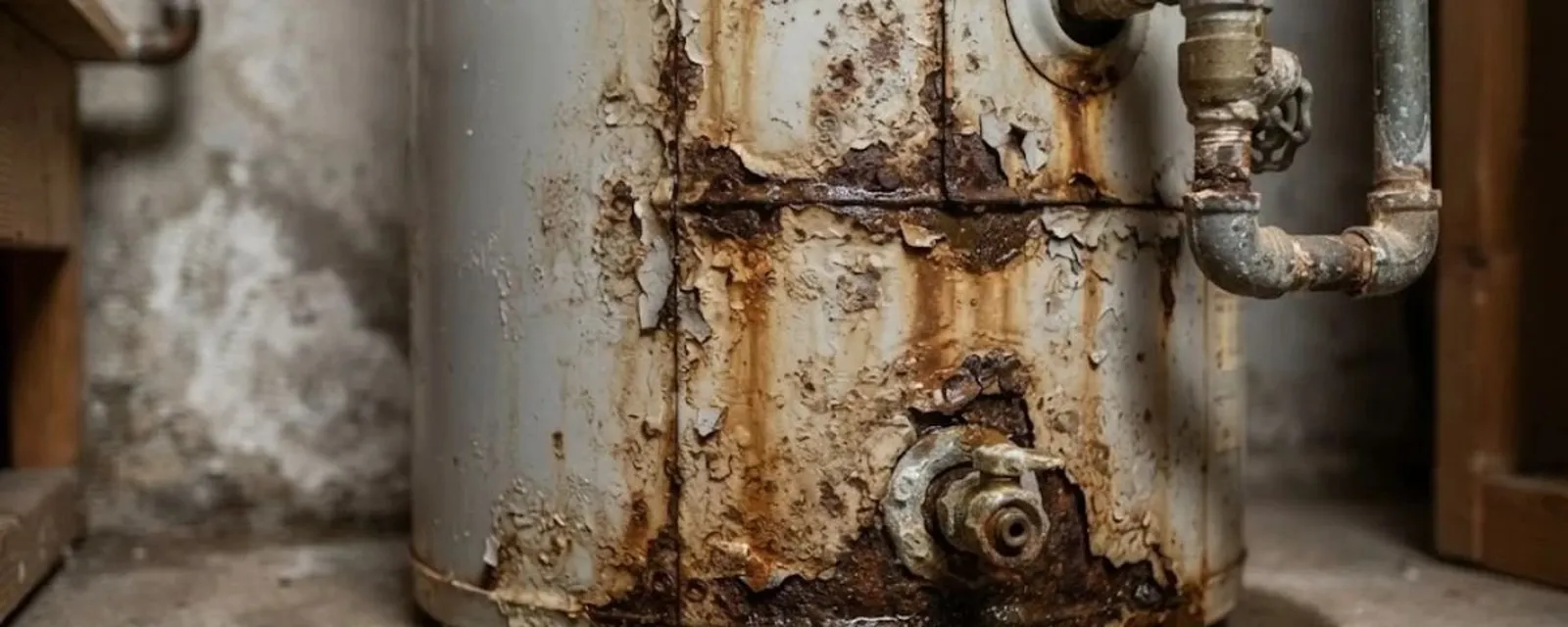
Seven warning signs
Water around the base
Wet floor under the tank is the one sign you should not wait on. A leak from a fitting or valve can be repaired. A leak through the tank wall cannot. Shut off the cold supply and the power or gas and look at where the water starts.
Rusty hot water
If rust-colored water comes out of hot taps only, the tank interior or the anode rod may be corroding. If the cold taps run rusty too, the cause is likely upstream. See the Melrose note below before you decide.
Rumbling or popping
Sediment settles at the bottom, traps water under it and boils it into noise. A flush may help. If the sediment is thick and the noise continues, the tank is working too hard and wasting fuel.
Age past ten years
Most storage tanks last roughly 8 to 12 years, and that varies with water quality and care. Find the date on the data plate. An older heater that starts misbehaving is a replacement candidate.
Not enough hot water
Shorter showers can come from a failed heating element, a bad thermostat, or a tank full of sediment. A newer tank with this issue often needs a repair. An old one often needs replacing.
Pilot or burner trouble
A pilot that will not stay lit, a yellow flame, or soot around the burner needs attention. A bad thermocouple is a cheap fix. A cracked heat exchanger or draft problem is not.
Metallic taste or smell
A rotten egg smell from hot water only often points to a reaction in the tank. A metallic taste can come from corrosion. Both are worth a look when the tank is also old.
One sign on a young heater is a repair conversation. Two or three on an old one is a replacement conversation.
Repair or replace: a quick decision table
| What you see | Heater age | Likely path |
|---|---|---|
| Leak from tank body | Any | Replace, since a failed tank wall cannot be repaired |
| Leak at a valve or fitting | Under 8 years | Repair the valve, then monitor |
| No hot water, gas model | Under 10 years | Repair: thermocouple, gas valve or igniter |
| No hot water, electric model | Under 10 years | Repair: element or thermostat |
| Rumbling and sediment | Over 10 years | Flush once, plan replacement |
| Rusty hot water only | Over 10 years | Replace: interior corrosion is likely |
| Repeated repairs in one year | Over 8 years | Replace, since repair costs add up |
A general guide. A plumber looking at your actual unit may reach a different call.
As a rule, if a repair costs more than about half the price of a new heater and the tank is past 8 years, replacement is the better value. That depends on your unit, not a rule of law.
Not sure if it is the heater?
Describe what you see and when it started. We will tell you if it sounds like a repair or a replacement before a truck rolls.
How we think about repair versus replacement
Start with the leak test. Dry the area, wrap a paper towel around the suspect fitting and see where it gets wet. A drip from the pipe connections or relief valve is a repair for water heater repair service. Water from the tank seam or bottom is not.
Next, ask about parts and cost. An electric element or thermostat is inexpensive. A gas control valve on an older tank can cost nearly as much as a new unit. Efficiency matters too. Modern heaters are better insulated, which lowers standby loss, so a water heater replacement can pay for part of itself over time. How much depends on your usage.
Melrose note: rusty water, main flushing and permits
The City of Melrose ran citywide water main flushing in 2025 from Monday, September 8 into late October, generally 8 am to 4 pm. During flushing the city warns that water may look rusty or cloudy, to run cold water until it clears, and to hold off on hot water, laundry and the dishwasher until it does.
If your water turned rusty while the city was flushing, test the cold tap first. If cold is rusty too, it is probably the main and not your heater.
Melrose gets its water from MWRA, which adjusts pH and buffering to reduce corrosion in pipes. That helps, but it does not stop an old tank from rusting out from the inside. On the permit side, the city's fee schedule lists a water heater at $40, and a residential gas water heater at $40 as well. Ask your plumber who applies for the permit and when the inspection is scheduled.
Source type: City of Melrose water flushing and permit fee pages, MWRA annual water quality report
What to do the day you suspect a failing heater
- 1
Check for water
Look at the floor and the tank base with a flashlight. Photograph any wet area.
- 2
Shut off the energy source
Turn gas control to off or flip the breaker for electric. Never leave a leaking electric tank powered.
- 3
Close the cold inlet
The shutoff on the cold line stops more water from filling the tank.
- 4
Note the data plate
Take a photo of the model, serial and capacity. It speeds up quoting.
- 5
Call and describe
Tell us what you see and the heater age. If the floor is flooding, say so.
If you smell gas, do not stay to troubleshoot. Leave the building and call the gas utility or 911 from outside.
Replacement day checklist
- Clear a pathMove boxes and stored items away from the heater and the route to the stairs.
- Ask about old partsValves, flex lines and venting often get replaced with the tank.
- Plan the water shutoffYou may be without water for a few hours. Fill a few jugs.
Questions we hear
Storage tanks commonly last roughly 8 to 12 years, but water quality, sediment and maintenance affect that. The city's water is treated to limit corrosion, so check the age on your data plate rather than guessing.
Not necessarily. The city flushes mains and warns of rusty or cloudy water in the process. Run the cold tap until it clears, wait to use hot water and laundry, and then see if it returns. If only hot water is rusty after it clears, call us.
Many owners drain a few gallons annually to clear sediment, following the manual. An old tank may not hold up to it, and a stuck drain valve can start a leak. If yours is past 10 years, ask first.
It is a metal rod inside the tank that corrodes instead of the steel. Once it is used up, the tank wall is next. Checking or replacing it on a younger tank can add years.
The city's fee schedule lists a water heater at $40, so ask your plumber and Inspectional Services whether your replacement needs a permit. Plumbing and gas permits are applied for online, and staff review can take 2 to 3 weeks.
It can be, especially if space or hot water supply matters. It costs more upfront and needs the right gas line and venting. Ask for a comparison on your own house.